
Find out what stage of your transition you're in
Your hormonal profile, rebuilt.

Tired of generic menopause scores? We are too, and we just fixed it.
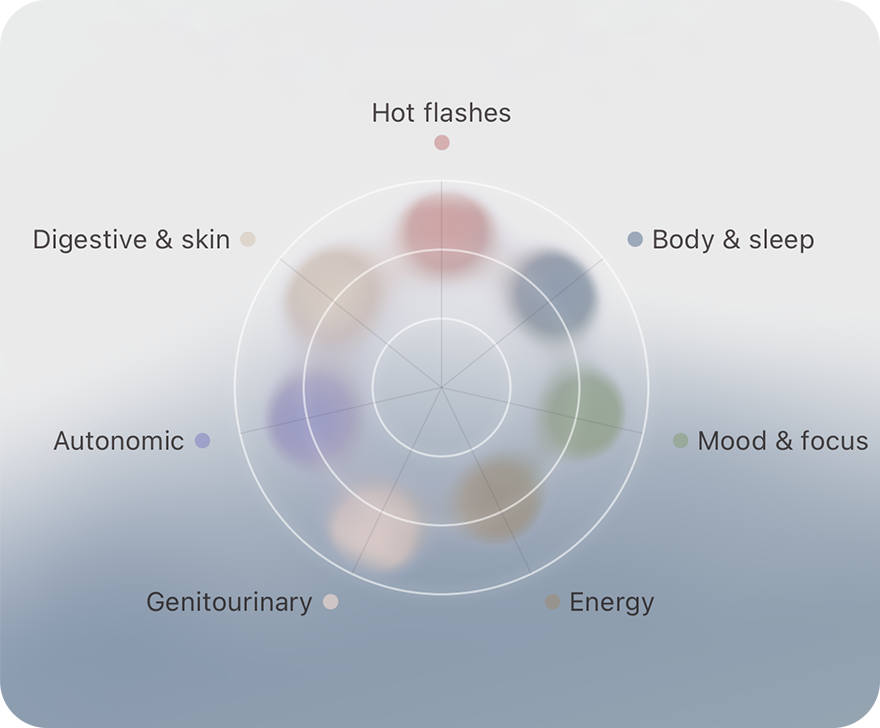
We just launched a new version of the Give Zero assessment in the app. It’s a tool to help you understand what you’re going through.
When I started with perimenopause symptoms I went online to find a tool that would tell me if I was in it or not. It drove me crazy that I kept finding a single “menopause score” that felt generic and pointless. “You are more or less in perimenopause.” What was I supposed to do with that?
I decided to build something new. The Give Zero hormonal assessment reads the pattern in your symptoms and matches you to a phenotype, a recognizable model of how the transition actually shows up in your body and mind. One woman is running on empty with brain fog and low mood; another is dealing with hot flashes and disrupted sleep. Treating those as the same thing has never made sense to me.
Two women can have the exact same severity score, and be having completely different experiences.
The old scales
For decades, the standard tools, like the Greene Climacteric Scale, worked like a fixed checklist. You rate a set list of symptoms, the numbers get added up, and out comes one total severity number. It’s simple, and for its time it was genuinely useful. But it has three real limitations that matter for how you feel day to day:
It treats everyone the same. A single score flattens very different experiences into one number. It can tell you how much you’re struggling, but not how you are. And the “how” is what actually points to what might help.
It ignores where you are in the transition. Perimenopause and postmenopause are not the same terrain, and symptoms shift as you move through them. In fact, research shows physical symptoms are often more severe during perimenopause than after (Khalaf et al., 2025), something a flat checklist can’t capture. Our assessment is built on the STRAW+10 staging framework, the clinical gold standard (Harlow et al., 2012), so it reads your symptoms in the context of your actual stage.
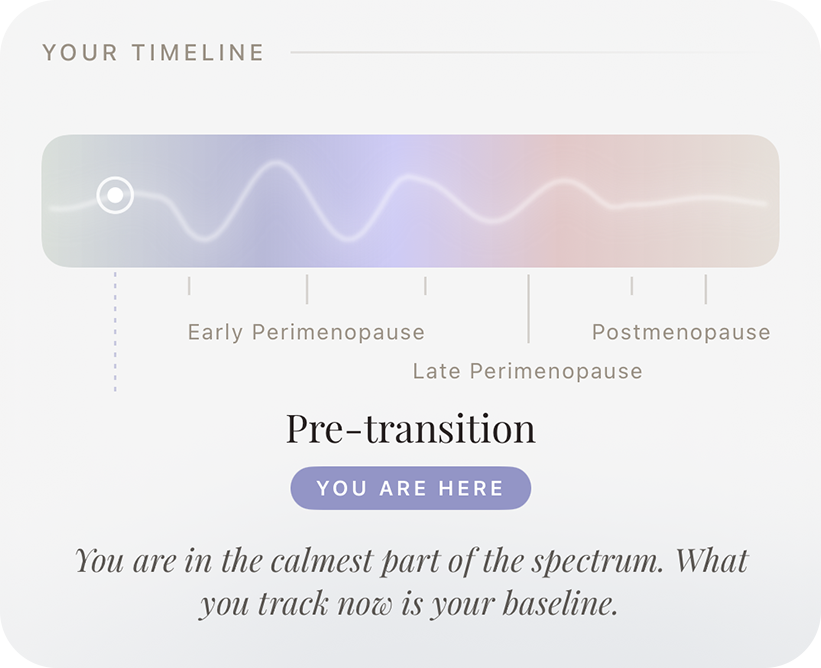
It assumes your cycle doesn’t matter. It still does. Whether your periods are regular, irregular, or have stopped changes what your symptoms are telling us, so the new assessment uses your cycle regularity to set the right thresholds for you, rather than applying one rigid cutoff to everybody.
Our engine
The Give Zero engine is built on close to thirty peer-reviewed studies, including the most recent large-scale analyses, a big leap from the tools that shaped the older scales. A few examples of how we think:
Hot flashes aren’t the whole story. One of the largest recent studies found they can run almost independently of everything else you’re experiencing (Aras et al., 2025), so we stopped treating them as the headline symptom of menopause and started giving equal weight to the rest. We also know that if hot flashes are all you have, you may be better suited to targeted therapy, and we tell you so.
Mood shifts are central, not a side effect. In perimenopause specifically, frequent mood change turns out to be one of the most connected symptoms of all (Min et al., 2025); it pulls a lot of other things along with it. So we don’t just treat it as a cluster, we look at its cascading effects on the other symptoms you have.
Brain fog is real and specific. It isn’t vague forgetfulness; the research points to verbal learning and memory as the areas most affected during the transition (Maki & Jaff, 2022).
Not everything is perimenopause. Some of the most common symptoms (fatigue, anxiety) show up at high rates in women before, during, and after the transition (Aras et al., 2025). On their own, they don’t tell us where you are or what pattern you’re in, so we don’t just fold them into a scale that inflates your severity. We call this the Universal Background Layer: we take these symptoms seriously and track them as their own background burden.
We see the whole picture, not just the symptoms. Your symptoms don’t exist in a vacuum. The engine takes in the factors that shape your unique transition: whether you smoke, how much you move, what your diet looks like, even the age your mother reached menopause (one of the best clues we have for your own timing). These are some of the biggest levers on whether symptoms ease or intensify, and many are things you can influence. Putting them together with your symptom pattern is what turns a snapshot into a plan: not just “here’s what you’re experiencing,” but “here’s what’s likely making it harder, and here’s where you have room to move.”
What this means for you
When you take the assessment, you’re not getting a grade. You’re writing this moment of your story, of your unique pattern, one grounded in the best available science and tuned to your stage and your cycle. That’s the foundation for guidance that actually fits your experience, instead of generic advice aimed at an average that doesn’t exist.
It’s live in the app now. If you’ve taken the assessment before, it’s worth doing again. You may be surprised by how much more it sees.
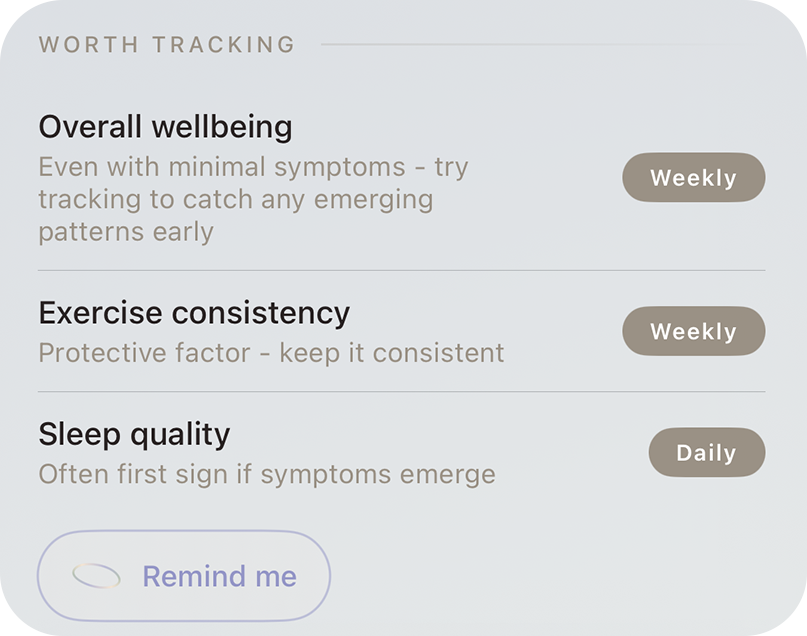
Because your story evolves and your symptoms will keep changing, we’ll nudge you to take a light version of the assessment every 4 weeks and a full re-baseline every 6 months. That way you can look back and understand what moved your story forward, how you’re evolving, and hopefully make more sense of this challenging moment in your life.
No more guessing.
Give Zero decodes your data to help you anticipate your menopause symptoms.
Download Give ZeroFree on iOS and Android